Wednesday, December 7, 2011

Make my day, Short-eared Owl

Cruising down the beach.
The light was bad, the day was blah, I was cold, the place was dead, nothing was flying and I was out of time.  I had been walking quietly  along the backshore at Keystone Spit with my camera and was going to write off the day as birdless.

In fact I had just turned back toward my car when this Short-eared Owl took wing in front of me.  I snapped many blurry images while the lone focal-point of my telephoto scanned the empty, white sky, trying to lock onto the bird.

Watching me.
Short-eared Owls are a special treat. In my forest setting at home I see only Great-horned Owls and Barred Owls.  My only Short-eared sightings have been at Keystone. 

I was on my way to seven hours of meetings in Coupeville and had left home a few minutes early to swing past this area on the long-shot chance I might stumble upon a migrating Snowy Owl.

Short-eared Owls are right at home in the wide-open landscape around the Keystone Ferry Terminal. They favor open grasslands where they can fly low and hunt rodents, particularly voles. These owls will hunt not only at night but also during the day. This one seemed to favor the beach and certainly was not sleeping.

Still watching me through the tall grass.
As always, the challenge when photographing birds is not to disturb or stress them. This one never took its eye off me, so I kept my distance. There were no memorable images from this outing, but simply seeing the owl made my day.

It kept me smiling and happy through seven hours of meetings in hard, straight-backed chairs.

Saturday, November 12, 2011

Hunting for what really matters


Watching this female Northern Harrier at Crockett Lake the other day I couldn’t stop thinking about why I am so happy.

It’s because I love living so close to nature.  The harrier glides effortlessly over the marsh, studying everything that moves. Watching such a specialized hunter relaxes and fascinates me.  It reminds me that we have much in common with our wild cousins. We all have a niche to fill and need wholesome places to live and hunt. We have a new generation to raise.  To survive, we must adapt and learn, pick our battles and focus on what really matters.

But everything comes with tradeoffs.  The price of a rural, island lifestyle is that we don’t have as much convenience – or stress -- as we did where we came from.  Prices are a little higher but the payback is priceless. That, to me, is "what really matters."

We locals love to say we support our small-town shops.  They provide jobs and tax revenue to strengthen our local economy.  They are a big part of what makes our communities distinctive, charming and vibrant.

So I was horrified when a friend told me of this conversation she overheard the other day in a local shop.

“I’m thinking about ordering this book,” a customer asked the bookshop owner. “Can you beat Amazon’s price?”

“Oh hi, Sis!” the owner said.  (Yes, it really was the owner’s sister.)  “Let me check.”  A moment later the owner explained, “I’ll be glad to order it for you but it’ll be about $2 more.”

“Oh, don’t bother,” her sister said. “I’ll order it from Amazon.”

Please think about the implications of this on several levels.

To get into the right mental frame for some clear thinking, may I suggest an hour with the harriers at Crockett Lake?

Saturday, October 29, 2011

Going out with a bang

Sometimes it is enough just to appreciate what is right outside the door.
 
Vine Maple.
Pin Oak.


Katsuras.
Fothergilla.
William's Pride apples.
Japanese Maple.
Huckleberries to feed the birds this winter.
Hydrangea.
Blueberries. We ate all the blue parts. Sorry.
Vine Maple.
Crabapples - a feast for the birds when the cold weather hits.
Rose Hips for the birds, deer, squirrels, rabbits and other visitors this winter.
Pin Oak, just because we like it.
Katsura leaves. The birds will dig under these for winter food.
Hard times are ahead. Please remember those who struggle.


Saturday, October 22, 2011

Finding a vision for island living


Our vine maple, one of nature's weed trees.
I love this season of colorful vine maples and ripening huckleberries in our half-wild back yard. We live in a forest setting so you might say the view never changes – just trees and sky.

But what's changing constantly for Sue and me are the birds and wildlife that come and go all day.

We look up and see deer grazing or a coyote slinking across the yard. We check a certain tree overlooking our orchard and find Bubba, our owl friend, sleeping off a hard night. And we dodge fir cones the squirrels rain down on us as they strip the trees to stockpile reserves for the winter. 

A Cedar Waxwing brings salal berries to its young in our yard.
Moving here from the city in the 1980s my intentions for the yard were quite different. My dream was to eradicate the native brush and rotting snags and replace them with a weedless, sterile lawn and the kinds of flowers I’d admired for years in city yards.

With power tools and poisons, I would conquer every square inch of our yard, rid our view of huckleberries, pave our gravel road and plant a rose garden.

This season's huckleberries are plumping up right now.
I asked a local nursery about chemicals to kill weeds and moss, grow grass, and stamp out fungus and Black Spot. To my surprise, they answered as non-judgmentally as they could that they didn’t carry poisons or encourage their use.

It took me a long time to get that it isn't a step forward to conquer and replace nature -- just the opposite. Huckleberries and salal are a magnet for the birds and animals that now bring beauty and mystery to our lives every day. These hardy bushes provide shelter to ground-nesting birds,  rabbits and voles, which attract other wildlife to our yard to hunt.

A Red-breasted Sapsucker eats our huckleberries.
Some might say an old, rotting snag is ugly, but it’s beautiful if you love the sensational Pileated Woodpeckers that come to jackhammer it.   

Last summer we watched elegant Cedar Waxwings feed their gangly newborns in a tree by our deck. And we delighted when Northern Flickers brought their vulnerable young to peck ants from our crumby lawn, which is riddled with dandelions the rabbits eat. Every winter, our berry-laden bushes attract colorful visitors such as Red-breasted Sapsuckers to brighten the view outside our windows.

Like many other people, we put out a hummingbird feeder each spring to welcome the tiny Rufous Hummingbirds that migrate thousands of miles to return here -- specific individuals often showing up in the same yards where they were banded in past years! But we don't kid ourselves. We know they aren't here for a few cups of sugar water in a plastic dish. They come in droves for the blossoming salmonberry bushes that grow wild in the woods.

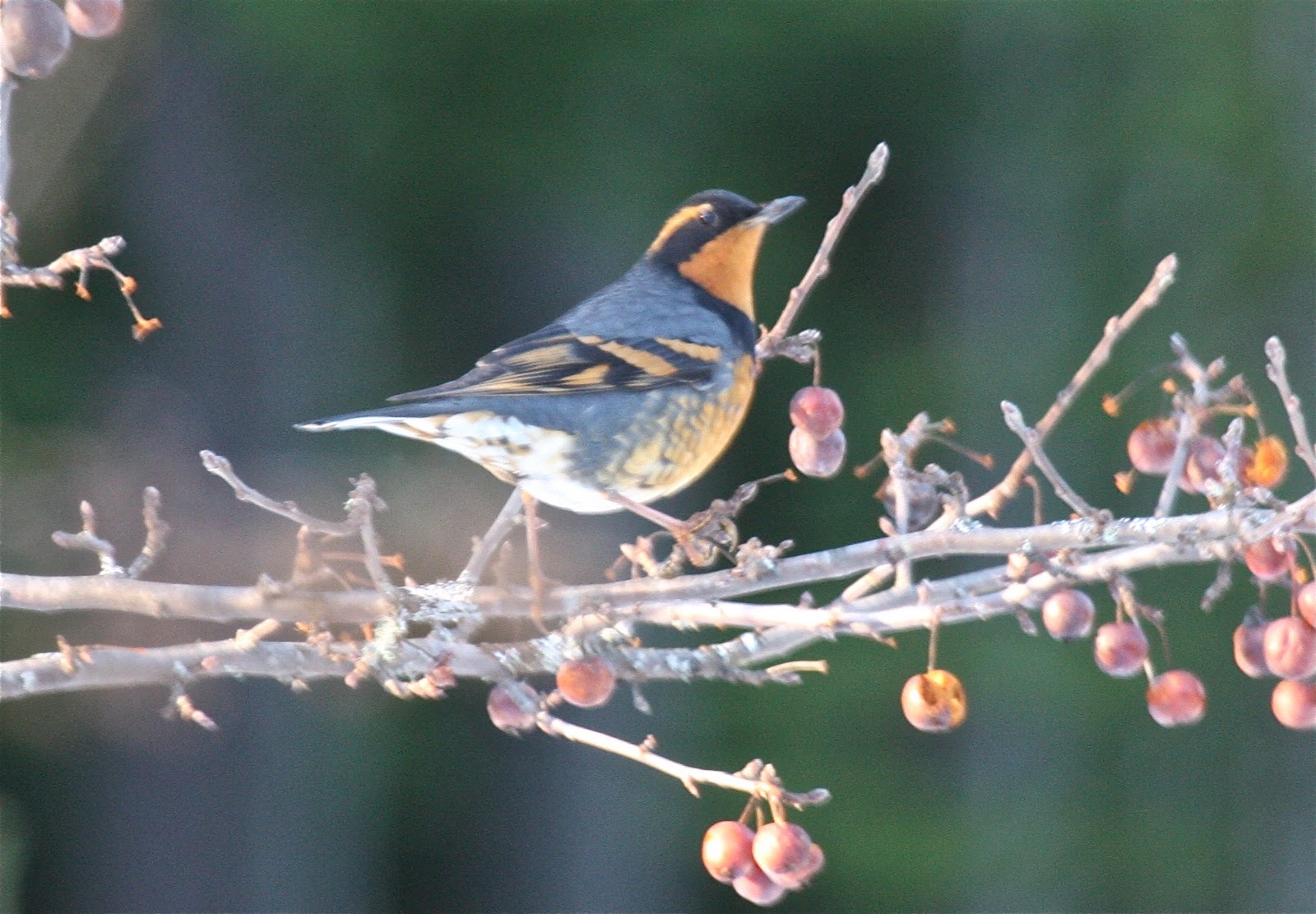
This Varied Thrush had a winter feast on our crabapples.
The wild creatures are a huge part of our quality of life. It's one of the reasons Sue and I support Whidbey Camano Land Trust in their work to preserve farms, forests and other healthy habitat.

I've gradually learned we don’t have to control everything. Better to leave nature alone as much as reasonably possible so it can create something beautiful. If we interfere too much, we’ll just screw it up and make a poorly-functioning, problematic mess.

Sue and I were guests recently at the waterfront home of a gracious couple who live on a high bluff overlooking Puget Sound. They watch boats all day.  They are enjoying their golden years dining on crabs and salmon they catch from their own boat in front of their own home. It’s the Puget Sound dream!

What could be healthier than fresh salmon?  Well, just not too much, too often, because the flesh might be somewhat toxic. The experts say it's probably safe in moderation, but be careful if you're pregnant or nursing. That's the flip side of the Puget Sound dream.

This handsome young coyote had a sweet tooth for Gravensteins.
Our friends' view is breathtaking.  But as is typical of high-bluff properties, they have a long pipe called a tight-line that carries roof runoff including any moss-killing products down the bluff to the beach, where forage fish lay their eggs. Salmon feed voraciously on those forage fish, to the extent that they hatch and survive.

This couple’s pride is their perfect front yard, a fairyland of manicured beds, interconnecting lawns, vegetable plots and winding paths. They've cleared the trees and brush and scraped away centuries of ground cover.

"Bubba," the Great-horned Owl, is our rodent police.
Now to their dismay, their new lawn is sprouting buttercups – even after they applied weed-n-feed. Their vision is to gaze at a deep, lush carpet of green, so they asked us about products to kill the broadleafs.

“It depends on your values and vision,” I blurted, then instantly regretted the edge in my voice. The last thing I wanted to do was attack the wonderland our hosts had worked so hard to create.

What I wanted to explain is that beauty means different things to different people. I’ve come to believe the most beautiful and joyful thing in my world is to live in a place that is healthy for wildlife and humans.  Buttercups aren’t so bad. Weeds grow where we disturb the soil, but not where nature runs the show.

Even this guy makes us smile.
Plants need excessive watering when we introduce the wrong ones. Leave nature alone and it will choose the right, drought-tolerant plants. Grass is a good ground cover for septic drain-fields but not much else when you live in a climate of dry summers and moss-promoting winters.

Of course most people don't have the space to live quite as wild as we do. But even in a built-up neighborhood -- in fact especially there -- why not steer away from chemicals?  Keep some natural ground cover and pursue a different vision. Offer the wildlife a sliver of wild habitat, safe food and clean water.  If we all do that, our earth and marine waters will be healthier.

Blacktail deer bring quiet grace to our forest setting.
To me, a few yellow flowers in a lawn aren’t ugly; they’re beautiful. They make a statement about what's really important versus just cosmetic.

They are a sign the birds can bring their young to eat from that lawn without getting poisoned, and that we aren’t poisoning the ground from which we draw the previously-used water we drink every day of our lives.

Everything is connected. Beauty is more than skin deep -- much, much more.

Tuesday, October 11, 2011

Face-to-face at high noon

I'm watching you watch me.
It's a shock to look up and see a face like this looking back at you. I was working at my desk about noon today when something in the garden crossed my peripheral vision, just outside the window. I shot a few photos through the window and then headed out to investigate. After searching a bit I noticed a handsome set of ears pointed my way from about 20 feet off, behind a clump of salal. The coyote hung around for several portraits, took a couple steps closer to study me, then slid under the garden fence and trotted away.

Two hours later it was back for another go!

I love canines and have shared the best years of my life with dogs. But coyotes are a special thrill because they're the wild cousins of our best friend. Dogs cast their lot with mankind thousands of years ago and we've been partners ever since. If you haven't known the love of a dog, you are the poorer.

Many people are a bit less forgiving of coyotes. They can cause grief for some, but I am drawn to them because they're wily and adaptable enough to go it alone in the world. Man can't control quite everything; thank goodness.

Sizing up the garden.
This young coyote has been hanging around lately. It may be here for the leftover fruit from our apple trees. Coyotes are carnivores and eat mainly voles, insects, reptiles, birds and other small game. And yes, domestic cats. But they are opportunistic and also eat fruit in the autumn.

I think it's pretty gutsy of this coyote to come inside the perimeter fence of our garden, from which the escape avenues are limited.  It must have a good reason to visit twice in one day, in broad daylight, and the reason probably is food.

But let's make that three visits in 24 hours. Our "security man," Duncan, sleeps in the house.  His plush bed at the foot of the stairs provides a clear view of the deck through a glass door, and apparently he sleeps with one eye open. He got us up about 12:00 last night with some fierce barking, which is unheard of.  I heard something scamper across the deck.  In hindsight, it probably was this same coyote.

I don't know if our 40-pound Duncan really wants to mix it up with a coyote, but that's what he'd like the coyote to believe. We aren't very eager to encourage a confrontation for either party's sake.

Sleeping with one eye open these days.
In any case, our little sawed-off Border Collie (with the short legs of a Corgi) is walking pretty tall right now. The little dog with a big spirit has found himself a serious job in the household, and that is every dog's dream.

Wednesday, September 21, 2011

It's not just a game


Steller's Jay. Very bright. Very wily. Fast learner.
Sitting on my friend’s deck the other afternoon it was hard to say who was exploiting whom.

Craig was tossing peanuts to the Steller’s Jays and I was taking pictures. The bolder birds were picking up nuts and weighing them before putting them down to check the next one.  Half-a-dozen nut thieves were lurking on low-hanging branches, poised to swoop down if Bird #1 took its eye off the prize.  The challenge for Bird #1 was not to lose the nut it had just checked, in case it was better than the one it was about to pick up.

Everyone was having a high time – Craig, the Jays, the nut-thieves and me, taking pictures.

Getting great close-ups is easy with the new digital SLRs and zoom lenses.  Thousands of people are taking up bird photography, amassing big photo collections. For some it is strictly a game with no purpose but to keep score and pile up images.

Bird #1 weighing the options.
That’s sad because even a hobby as “harmless” as photography can do more damage than good if we don’t know or care much about birds. If my only objective is to get a better photo than the next guy, then what’s to stop me from tromping across sensitive wetlands and wildflowers, plowing off the trail, approaching too close to nests, interfering with the young, using an audio device to lure birds from shelter, spreading disease with a dirty feeding station, and stressing and flushing birds into the air? That’s exploitation, and for no better reason than sheer ego.

Craig offers many ideas to make bird photography more enjoyable and meaningful. Rule 1 is a no-brainer: Love the bird.  Here are some more of his thoughtful ideas:

  • Learn what birds eat and how they hunt. Learn how they raise their young, where they migrate and what habitat they need.
  • Take photos that shed light on their behavior and diet.
  • Share your knowledge and photos with others so they may also learn.
  • Put your best photos into a presentation and give a talk about birds.
  • Join your local Audubon chapter.
  • Let Audubon or other educational groups use your best images.
  • Take an ornithology class online.
  • Create bird-friendly wildlife habitat in your yard, with natural foods they like, free of pesticides.
  • Maintain some brush and wildlife snags.
  • Support organizations that protect and restore habitat.
  • Keep bird feeders and bird baths clean.
  • Keep a respectful distance – don’t stress the birds or any wildlife. 
The more we know, the more we care, and the more fun everything gets.


    Wednesday, September 7, 2011

    Getting along with the neighbors

    Deer compete for everything in our yard -- apples, plums, blueberries, raspberries, peas, green beans and pretty much all flowers and vegetation. We've built Fort Knox around the precious blueberries and a token fence around the vegetable garden, but are conceding most of the rest.

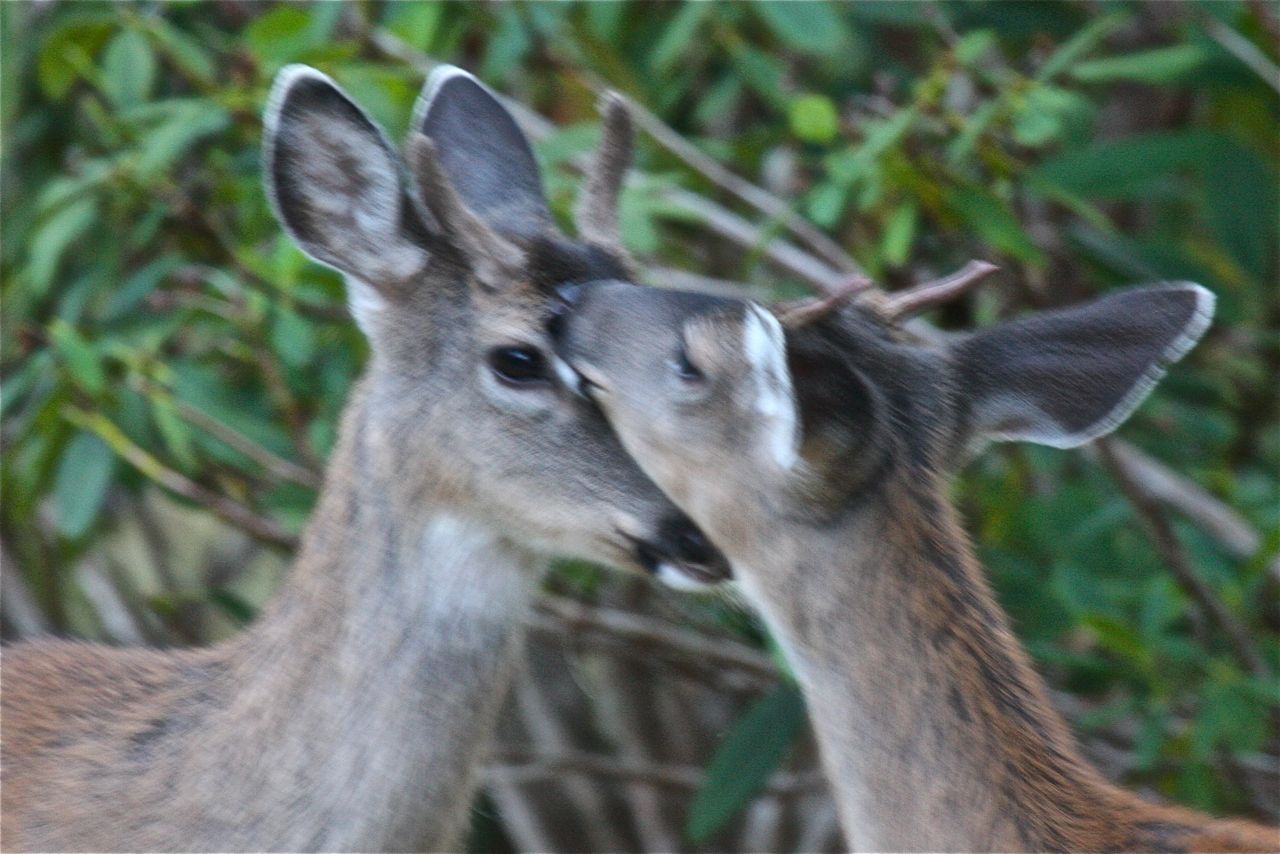
    That said, these two young Blacktail bucks are growing on me. They show up every evening around dark and are increasingly at ease with us. They were grazing by the garage the other evening when I hit the remote opener. The door opened with a wrenching screech, but all these guys did was raise their necks calmly and look around.

    One thing I've learned from my friend, Craig Johnson, is that all animals have individual personalities and are quite capable of learning and building trust. In any group of animals, a few individuals will stand out as risk-takers and be the first to approach for a reward. Others are especially wary.  Given how we humans treat many wild creatures, wariness serves them well and is an obvious survival strategy.

    These two young bucks seem particularly curious and not as wary as most.  When I walk toward them with the camera, sometimes they take a step or two toward me.  I get the feeling they're studying me as much, or more, than I'm studying them.  Craig's phenomenal success at building trust with individual birds, squirrels, raccoons and other wildlife in his yard is a reminder that we share the same space with the animal kingdom. If we like having them around on Whidbey Island, we might try a little tenderness, maintain some habitat for them and do what we can to reduce the stresses.

    Last night Sue and I had just returned from a walk with Duncan when the deer moved in. They romped playfully and groomed each other, helped themselves to a patch of green grass, and stared when I approached with my big camera.

    The two stay close together, their faces sometimes touching or inches apart. I'd been assuming they were siblings but now realize that's unlikely.  Black-tailed deer apparently are sociable only within their own sex. Upon reaching maturity at 16 - 18 months, a young buck leaves its family group and sets out to find a male bachelor group. At some point, of course, competitiveness gets a bit serious, but with our two young visitors it's all tenderness and socialization.

    I like that. We're enjoying the neighbors.