Note: My best tip for anyone planning to attend Sound Waters University, Saturday, Feb. 5, at South Whidbey High School, is to sign up for any class taught by Craig and Joy Johnson. They photograph and paint wild birds, write about them, publish books and educate. This year they are teaching "The Woodpeckers of Whidbey Island." To get on the mailing list for Sound Waters enrollment, which opens Jan. 7, click here: Sound Waters University, and then click on the blue button marked "Join our Sound Waters Mailing List." For more about wild birds: Craig and Joy Johnson's website.
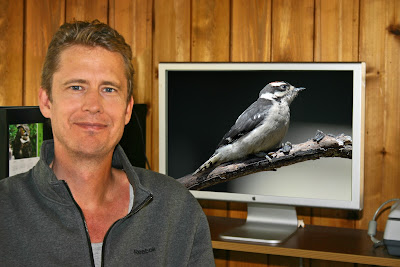 |
| Craig Johnson with a little Downy Woodpecker on the screen saver. |
By DAN PEDERSEN
Is it crazy to think that specific birds coming into Craig Johnson's yard in Freeland recognize and trust him? I don't think it is. The winged activity in Johnson's yard on any given afternoon is a complex drama with many sub-plots. In the middle of it all, studying every detail and loving it, sits Johnson.
Researchers have documented that crows recognize specific human beings and will hold onto a deep grudge against people who do them wrong -- even alerting their friends about these human enemies. Other crows learn second-hand to recognize these evil-doers and join in outbursts of angry scolding and mobbing in the future.
 |
| Male Pileated Woodpecker at Johnson's suet feeder. |
|
|
So it may not be a stretch to assume it also works the other way. Some of the birds that approach Johnson on his deck know they can trust him -- that he's one of the gentle, non-threatening, good guys. Some of Johnson's regulars are even Steller's Jays, corvids closely related to the crows.
"Oh, yeah, I think the big Pileated Woodpecker recognizes me for sure, just because I see that individual bird so much," Johnson says. "He knows I'm here. As long as I am mindful and don't make any sudden moves he will stay on the tree and won't fly away." The tree is just a few feet away.
"And I'm probably getting some of the same Northern Flickers over and over." Johnson is generous with treats, tossing peanuts to the normally-wary Steller's Jays that sneak closer and closer on the overhanging limbs and hop toward him on the deck. "I can tell the difference between the different ones. Certain individuals will come almost within arm's reach."
 |
| Northern Flicker |
He laughs because the very shrewd jays and a gullible Douglas squirrel named G-Dog compete for those peanuts and steal from each other, but the jays always win. They watch G-Dog stash them. When he turns his back, they raid the cache.
All five species of Whidbey Island woodpeckers visit Johnson's yard, taking advantage of native landscaping, nearby conifers and a suet feeder. "The Downy and Hairy Woodpeckers can be very tolerant when you fill the feeder," Johnson says. "I'd say I've done more woodpecker photography in the yard than in the woods because our back yard is so uncontrolled. They come and bring their young. All the species have brought their fledglings here except possibly the Sapsucker."
Watching those juveniles is one of Johnson's great rewards. "I have many photos from our yard where the juvenile Northern Flickers are watching the dad -- very intently watching him -- and he's feeding them ants from the lawn. I mention this so that maybe a few people will decide they can get along without using insecticides. I've watched the juvenile Hairy Woodpeckers, watched the red nape patch move from the forehead to the back of the head as they grow. I love that, especially this year with my health."
 |
| Red-breasted Sapsucker |
The proof of all this yard activity is some sensational close-ups Johnson has taken with a simple point-and-shoot camera while sitting on his deck on sunny days. But this is where the story gets harder to write. Many people know of Johnson's incredible hand-held images taken with a big Nikon, single-lens reflex camera and a 400mm telephoto lens. Fewer people know Johnson no longer has that camera, nor the reason.
An aggressive, untreatable, neurological disease in the MS family is attacking his body, muscular control, vision, balance, computer-use, livelihood and, at times, mental focus. He cannot carry that camera any more nor go into the field to photograph birds. So now the birds come to him and that is an immense blessing.
"When you're out in nature it's inspiring. It's rejuvenating for me. When the birds come I don't think about my jobs or problems, or even my back ache. We don't have a TV here and haven't had one for 20 years. During the daylight hours in the summer especially, the outdoors is our break. I come out from my drawing table and sit on the deck and admire the birds. I'm thankful to have a yard like this, land that has not been over-groomed or controlled. Without that I wouldn't have the connection to nature. I'm not mobile. I'm very thankful the people who own this house agree (the Johnsons rent). They're on the same page."
 |
| Tiny, Downy Woodpecker on Madrone branch. |
"People come over here -- birders -- and say my gosh this is perfect habitat. The birders acknowledge all the ocean spray, the thrushes coming out, woodpeckers . . . This little madrona tree next to the railing here, most people would cut it down, but just in the last two months, every day, there have been Golden-crowned and Ruby-crowned Kinglets and Bushtits flitting about, sallying insects, and tons of Chickadees. Having a habitat in your back yard can be huge for just being able to look out your window and take a break from whatever you're doing."
"That's what I tell people. There is a lot going on and if you have a nice, groomed yard, you are missing out."
Johnson points out that in addition to the therapeutic, almost meditative benefits of watching birds, he also benefits in human relationships. As the Johnsons deal with Craig's illness, they are being showered with love and support by many members of Whidbey Audubon Society who cherish them for their years of generosity with photographic images, watercolor art and educational presentations.
 |
| Hairy Woodpecker drinking at a clean birdbath. |
"If you care for birds, you care for people," Johnson says. "Whether you love whales, trees, birds, a clean lake -- if you care about any of those things, you're also about humanity."
Johnson says he has never thought of himself as a photographer. "Not really. I've done it, yeah, but I just love birds. I wanted to capture the images so I could show others who might not have the time to see what the birds were doing. Bird photography was never to make money. It makes me feel better to just give the images to Whidbey Camano Land Trust or use them in our books. I do it to help nature and promote learning."
For their woodpecker presentation at Sound Waters University on Saturday, Feb. 5, Johnson says he hopes to inspire his audience and perhaps encourage them to learn a little more about woodpeckers and about the environment. "Maybe someone will decide to keep an old, dead snag in their yard instead of cutting it down."
 |
| Craig and Joy Johnson are the authors of a new children's book, The Amazing Hummingbird Story of Red Rufous, available for $9.95 plus tax from many island bookstores and shops, and elsewhere in the Puget Sound region. The book features Craig's beautiful watercolor paintings of hummingbirds and is highly educational. To order a copy directly from Craig and Joy, visit their website: http://pugetsoundbackyardbirds.com/ |


