Showing posts with label Craig Johnson. Show all posts

Saturday, March 24, 2012

Wildlife opened my eyes to the Land Trust's mission

 “That’s a baby great horned owl,” my friend Craig Johnson said of the image I’d just emailed him. “These beautiful owls are breeding in your woods because you have good, healthy habitat. They’ll help keep down the rodents in your garden.”

Bubba kept us entertained all spring.
I hadn’t thought much about owls or even seen very many, though we often enjoyed their conversations in the evening and pre-dawn. I just thought the roly-poly, little guy perched on our blueberry cage was kinda cute and goofy. He was back in the same spot the next day, yawning, pacing, grooming his toes, and sleeping with one eye open.

Sue and I named the baby “Bubba” and watched him squawk and scream for dinner all spring. “Great horned owls take months to learn to hunt,” Craig said. We watched Bubba’s soft profile turn sharper as he caught slow-moving insects on the ground and gained the confidence to hunt small rodents from higher and higher perches. Bubba and his parents grew tolerant of me and my camera, letting me approach as often as I liked.

As Sue and I became better observers, we delighted in the other newborns in our woods: woodpeckers, coyotes, hawks, deer, raccoons, songbirds, rabbits, squirrels, bats, lizards, snakes, butterflies, and frogs. We were astounded to learn we had flying squir­rels but had never seen them because they fly at night. We became attuned to the birds’ voices, and the more we opened our eyes and ears, the more joy we took in them. We learned that the same individual humming­birds migrate back to our yard every spring, and started taking special pains to keep our hummingbird feeder fresh and clean.

We realized how poor our lives would be without wildlife, including the long-lived orcas and gray whales that visit our shores every year, and the salmon that are our icon. All wildlife need healthy habitat, and if we don't consciously preserve a place for them to live, we will carelessly destroy it - and them. 
 
We knew we were not alone in these feelings and discovered that many of our friends belonged to the Whidbey Camano Land Trust. They shared a passion and sensitivity that inspired us. I don’t remember even discussing with Sue whether to join; we just did. The Land Trust was where we belonged, and we’ve been members for many years now. Nothing makes us prouder than to be among Land Trust people, our most cherished friends and neighbors, at the summer picnic or on a land tour.

Decades from now, if Bubba’s offspring still live and breed in our woods, we will know we were good stewards. We are committed to this work not only for Bubba’s sake, but for those future generations of humans who will spend the best years of their lives finding peace, rejuvenation and inspiration right here at home.

Note: The woods are alive right now with returning Rufous Hummingbirds, baby owls, newborn woodpeckers and the din of chirping! Courtship is under way in a big way and it's a marvelous time.  I published this piece originally on a blog of Whidbey Camano Land Trust that is no longer maintained. Rediscovering it the other day, I realized the sentiments remain more true than ever.

Thursday, March 1, 2012

Saving a spot for wildlife


Like many people I did not move to Whidbey Island for the wildlife. But in time I discovered they defined my quality of life. Deer, coyotes, orcas, Redtail-hawks, gray whales, woodpeckers, owls and native chipmunks are why I live here. They bring me immense joy and peace.

Craig Johnson photographed this Double-crested Cormorant.
I watch and listen constantly. The more closely I pay attention, the more I learn about the animals' activities around me, and how they adapt, live and hunt. I’ve even come to value bats, snakes, lizards, butterflies and other creatures easily overlooked but no less wondrous. How did that happen?

I appreciate being part of a community that understands and shares this love of nature. Not surprisingly, I developed friendships with others who feel the same way and whose passion adds to my enjoyment. Many of the people I most admire are members of Whidbey Camano Land Trust.

A few years ago I made thank you calls to some of these people for their gifts to the Land Trust. I had many touching and humbling conversations. Some were people of means; others had little but shared what they could because they know habitat is important. Land is our greatest legacy to future generations and to the wildlife we love.

The Land Trust's 2011 annual report is just off the press and once again it puts the spotlight on wildlife that benefit from the many forests, farms, lagoons, beaches and other areas the Land Trust helps preserve as wildlife-friendly habitat.

This coyote and I watched each other while I snapped photos.
Many of the images in this year’s report were taken by my good friend, Craig Johnson, including the Double-Crested Cormorant on the front cover. He also photographed the Northern Harrier, Great-blue Heron and Douglas Squirrel on the inside.  I’m proud to share space in the publication with him. A young coyote I photographed a few months ago appears on the back cover. 

The Land Trust’s mission is: To protect the islands’ most important natural habitats, scenic vistas and working farms and forests in partnership with landowners and our island communities.

Even in this slow economy, the Land Trust in 2011 scored many land-protection victories. They secured conservation easements on two key properties protecting 97 acres of prime farmland in Ebey’s Reserve and received a donation of 16 acres of privately-owned tidelands on North Whidbey, giving the public access to 2.2 miles of west-side beach. They also earned accreditation from the National Land Trust Alliance. This is an extraordinary distinction awarded so far to only 158 of the 1,700 land trusts in the nation.

To all of you readers who are members of the Land Trust, thank you.  If you are not a member, please consider making a gift and becoming one.  Just open this link and click on "Donate." http://www.wclt.org/

Wednesday, September 7, 2011

Getting along with the neighbors

Deer compete for everything in our yard -- apples, plums, blueberries, raspberries, peas, green beans and pretty much all flowers and vegetation. We've built Fort Knox around the precious blueberries and a token fence around the vegetable garden, but are conceding most of the rest.

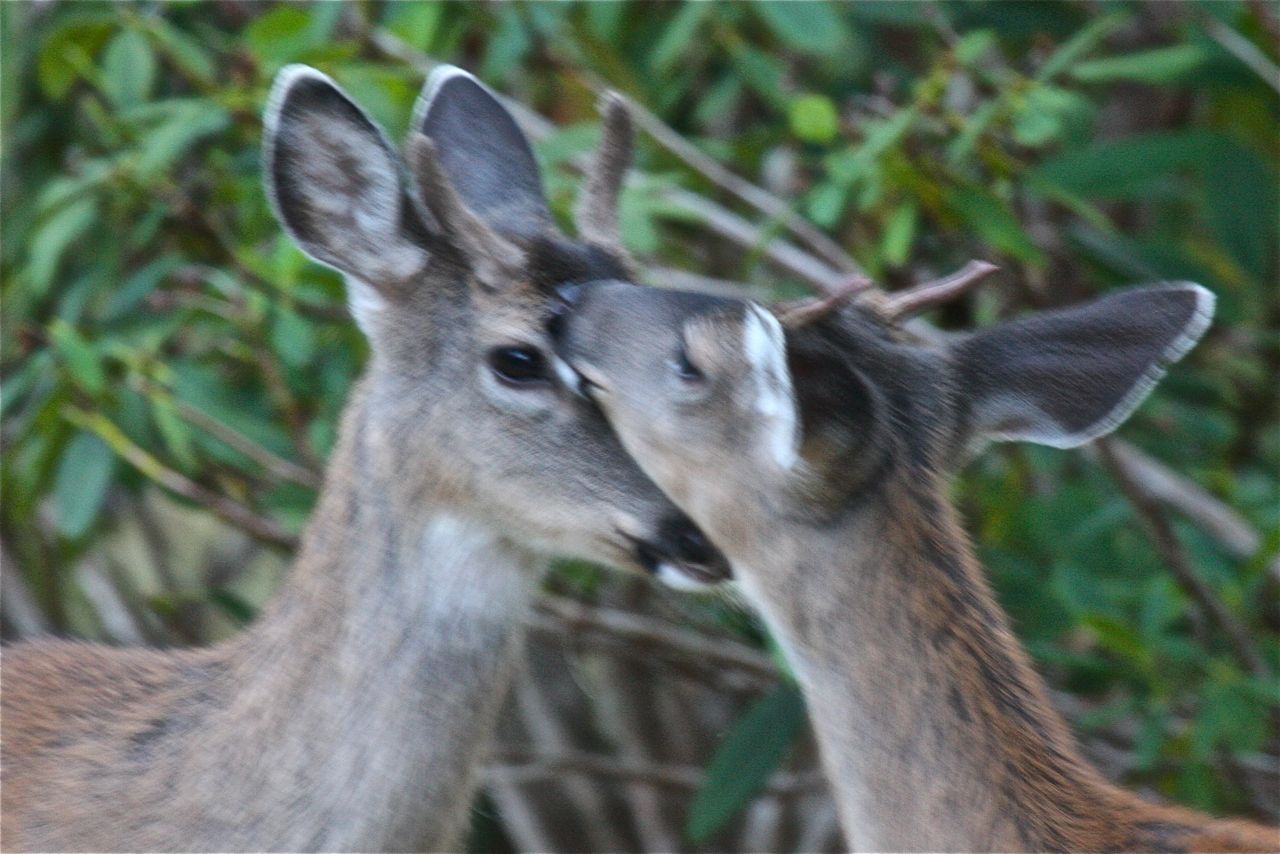
That said, these two young Blacktail bucks are growing on me. They show up every evening around dark and are increasingly at ease with us. They were grazing by the garage the other evening when I hit the remote opener. The door opened with a wrenching screech, but all these guys did was raise their necks calmly and look around.

One thing I've learned from my friend, Craig Johnson, is that all animals have individual personalities and are quite capable of learning and building trust. In any group of animals, a few individuals will stand out as risk-takers and be the first to approach for a reward. Others are especially wary.  Given how we humans treat many wild creatures, wariness serves them well and is an obvious survival strategy.

These two young bucks seem particularly curious and not as wary as most.  When I walk toward them with the camera, sometimes they take a step or two toward me.  I get the feeling they're studying me as much, or more, than I'm studying them.  Craig's phenomenal success at building trust with individual birds, squirrels, raccoons and other wildlife in his yard is a reminder that we share the same space with the animal kingdom. If we like having them around on Whidbey Island, we might try a little tenderness, maintain some habitat for them and do what we can to reduce the stresses.

Last night Sue and I had just returned from a walk with Duncan when the deer moved in. They romped playfully and groomed each other, helped themselves to a patch of green grass, and stared when I approached with my big camera.

The two stay close together, their faces sometimes touching or inches apart. I'd been assuming they were siblings but now realize that's unlikely.  Black-tailed deer apparently are sociable only within their own sex. Upon reaching maturity at 16 - 18 months, a young buck leaves its family group and sets out to find a male bachelor group. At some point, of course, competitiveness gets a bit serious, but with our two young visitors it's all tenderness and socialization.

I like that. We're enjoying the neighbors.

Friday, May 6, 2011

Bird lovers strike it rich with Craig & Joy Johnson’s fourth photo book


Just when I had given up hope there would be any more books of wild bird photography from Craig and Joy Johnson, they sprang a surprise.

.
About half the photographs were taken on Whidbey.
Our Pacific Northwest Birds and Habitat: Featuring the Puget Sound Area rolled off the press last week at Printing Control in Tukwila. The 100-page, landscape-style volume depicts 196 species. That's 16 more than their previous book. Craig photographed at least half of them on Whidbey Island. 

First copies will start showing up in island shops this weekend, and within days the handsome book will be on sale for $24.95 throughout the Puget Sound area. But you can request an autographed copy now by ordering it right from their website, http://www.pugetsoundbackyardbirds.com/.

At home in their backyard bird sanctuary. Pedersen photo
As with all of Craig and Joy's books, this one will be sold exclusively in independent bookstores, gift shops and wild bird stores -- not box stores, cookie-cutter chains or discount websites. The dollars and sales taxes it generates will go to work directly in the local economy where they are most needed, benefiting the authors, printers and shopkeepers of our island community and Western Washington. Craig and Joy printed just 2,000 copies and I predict they will disappear fast.

The Freeland couple's goal for this book was to make it educational and inspirational, with more emphasis than ever on the habitats in which different species live, eat, hunt and nest.

Craig visits with Dennis Paulson in April. Pedersen photo
To make sure of that, Craig asked a renowned bird expert and biologist, Dennis Paulson, to review the text and photography. Paulson offered many helpful suggestions, which they incorporated into the final version. 

Craig admits he and Joy had not expected to publish this book because they're broke from medical bills and lost income. But they've sown a lot of goodwill in the community through their generosity over the years. Some of it flowed back to them when a friend, Coupeville businessman Karl King of Kingfisher Books, offered to loan them the money to print the book. 

Karl King
As always, the Johnsons hope readers will buy the book from local bookstores and shops. In  case you’d like get to your copy from Karl King himself, his shop, Kingfisher Books on Coupeville’s Front Street, is open from 11 a.m.-4 p.m. six days a week, but closed Thursdays.

Craig and Joy also hope many people will order autographed copies directly from their website.  The price to the buyer is the same either way. But, by skipping the extra step of wholesaling, the Johnsons can recoup their up-front costs much faster when people purchase the book directly from them.

Now, a bit about what it took to print this book.

“It was an insane amount of work,” Johnson freely admits. No one who hasn’t done it can imagine the planning and hours of computer time it takes to design such a project, let alone take thousands of extraordinary photographs of birds, all hand-held with a heavy, zoom lens, at exceptionally close range.
 
At the printing plant while the press was rolling.
Then there is the actual printing -- the crucial part no one ever mentions and everyone takes for granted. Printing Control, in Tukwila, Wash., deserves some big compliments.

Clearly, this book is gorgeous and the color is flawless. That doesn’t happen by accident. Craig is a graphic designer, photographer, artist and former print salesman for the commercial printing industry, which means he pushed the limits all the way. Printing Control measured up to the challenge.

"Rufous" features Craig's watercolors.
For a printing job even to be satisfactory, everything must go right including the binding. This is a landscape-format book, which puts extra stress on the spine. 

Building greater strength into the spine added significant cost to the job and Printing Control simply ate it to stay within Craig’s budget. That says a lot about the printer’s commitment to the job and to the client. Printing companies, like every other business, are struggling hard with the economic downturn.

I am proud that Printing Control is the same company that produced my book, Whidbey Island’s Special Places. Last year Craig chose them to print a children’s book he and Joy wrote that features his watercolor art, The Amazing Hummingbird Story of Red Rufous. It is on sale right now in many Puget Sound area shops.


The big Heidelberg press at Printing Control.
I am also proud that the president of Printing Control, Bob Bracht, is a friend from my past life when I managed a magazine and other publications for Safeco Corporation. At that time Bob was a sales representative for a large, Portland printer and won our annual report business several years in a row. Between then and now, Bob’s career apparently prospered, with him coming to Seattle and becoming president of Printing Control.

Bob is not only smart, likable and knowledgeable, but fun-loving and enthusiastic. And he loves the Northwest, which may have something to do with Printing Control being the greenest, most environmentally-conscious printer in the Greater Seattle area and the first to win the top, five-star rating from EnviroStars. That’s one of the reasons Printing Control was the right company to print my book and also a brilliant choice for Our Pacific Northwest Birds and Habitat.