Showing posts with label Whidbey Camano Land Trust. Show all posts

Saturday, March 24, 2012

Wildlife opened my eyes to the Land Trust's mission

 “That’s a baby great horned owl,” my friend Craig Johnson said of the image I’d just emailed him. “These beautiful owls are breeding in your woods because you have good, healthy habitat. They’ll help keep down the rodents in your garden.”

Bubba kept us entertained all spring.
I hadn’t thought much about owls or even seen very many, though we often enjoyed their conversations in the evening and pre-dawn. I just thought the roly-poly, little guy perched on our blueberry cage was kinda cute and goofy. He was back in the same spot the next day, yawning, pacing, grooming his toes, and sleeping with one eye open.

Sue and I named the baby “Bubba” and watched him squawk and scream for dinner all spring. “Great horned owls take months to learn to hunt,” Craig said. We watched Bubba’s soft profile turn sharper as he caught slow-moving insects on the ground and gained the confidence to hunt small rodents from higher and higher perches. Bubba and his parents grew tolerant of me and my camera, letting me approach as often as I liked.

As Sue and I became better observers, we delighted in the other newborns in our woods: woodpeckers, coyotes, hawks, deer, raccoons, songbirds, rabbits, squirrels, bats, lizards, snakes, butterflies, and frogs. We were astounded to learn we had flying squir­rels but had never seen them because they fly at night. We became attuned to the birds’ voices, and the more we opened our eyes and ears, the more joy we took in them. We learned that the same individual humming­birds migrate back to our yard every spring, and started taking special pains to keep our hummingbird feeder fresh and clean.

We realized how poor our lives would be without wildlife, including the long-lived orcas and gray whales that visit our shores every year, and the salmon that are our icon. All wildlife need healthy habitat, and if we don't consciously preserve a place for them to live, we will carelessly destroy it - and them. 
 
We knew we were not alone in these feelings and discovered that many of our friends belonged to the Whidbey Camano Land Trust. They shared a passion and sensitivity that inspired us. I don’t remember even discussing with Sue whether to join; we just did. The Land Trust was where we belonged, and we’ve been members for many years now. Nothing makes us prouder than to be among Land Trust people, our most cherished friends and neighbors, at the summer picnic or on a land tour.

Decades from now, if Bubba’s offspring still live and breed in our woods, we will know we were good stewards. We are committed to this work not only for Bubba’s sake, but for those future generations of humans who will spend the best years of their lives finding peace, rejuvenation and inspiration right here at home.

Note: The woods are alive right now with returning Rufous Hummingbirds, baby owls, newborn woodpeckers and the din of chirping! Courtship is under way in a big way and it's a marvelous time.  I published this piece originally on a blog of Whidbey Camano Land Trust that is no longer maintained. Rediscovering it the other day, I realized the sentiments remain more true than ever.

Thursday, March 1, 2012

Saving a spot for wildlife


Like many people I did not move to Whidbey Island for the wildlife. But in time I discovered they defined my quality of life. Deer, coyotes, orcas, Redtail-hawks, gray whales, woodpeckers, owls and native chipmunks are why I live here. They bring me immense joy and peace.

Craig Johnson photographed this Double-crested Cormorant.
I watch and listen constantly. The more closely I pay attention, the more I learn about the animals' activities around me, and how they adapt, live and hunt. I’ve even come to value bats, snakes, lizards, butterflies and other creatures easily overlooked but no less wondrous. How did that happen?

I appreciate being part of a community that understands and shares this love of nature. Not surprisingly, I developed friendships with others who feel the same way and whose passion adds to my enjoyment. Many of the people I most admire are members of Whidbey Camano Land Trust.

A few years ago I made thank you calls to some of these people for their gifts to the Land Trust. I had many touching and humbling conversations. Some were people of means; others had little but shared what they could because they know habitat is important. Land is our greatest legacy to future generations and to the wildlife we love.

The Land Trust's 2011 annual report is just off the press and once again it puts the spotlight on wildlife that benefit from the many forests, farms, lagoons, beaches and other areas the Land Trust helps preserve as wildlife-friendly habitat.

This coyote and I watched each other while I snapped photos.
Many of the images in this year’s report were taken by my good friend, Craig Johnson, including the Double-Crested Cormorant on the front cover. He also photographed the Northern Harrier, Great-blue Heron and Douglas Squirrel on the inside.  I’m proud to share space in the publication with him. A young coyote I photographed a few months ago appears on the back cover. 

The Land Trust’s mission is: To protect the islands’ most important natural habitats, scenic vistas and working farms and forests in partnership with landowners and our island communities.

Even in this slow economy, the Land Trust in 2011 scored many land-protection victories. They secured conservation easements on two key properties protecting 97 acres of prime farmland in Ebey’s Reserve and received a donation of 16 acres of privately-owned tidelands on North Whidbey, giving the public access to 2.2 miles of west-side beach. They also earned accreditation from the National Land Trust Alliance. This is an extraordinary distinction awarded so far to only 158 of the 1,700 land trusts in the nation.

To all of you readers who are members of the Land Trust, thank you.  If you are not a member, please consider making a gift and becoming one.  Just open this link and click on "Donate." http://www.wclt.org/

Saturday, October 22, 2011

Finding a vision for island living


Our vine maple, one of nature's weed trees.
I love this season of colorful vine maples and ripening huckleberries in our half-wild back yard. We live in a forest setting so you might say the view never changes – just trees and sky.

But what's changing constantly for Sue and me are the birds and wildlife that come and go all day.

We look up and see deer grazing or a coyote slinking across the yard. We check a certain tree overlooking our orchard and find Bubba, our owl friend, sleeping off a hard night. And we dodge fir cones the squirrels rain down on us as they strip the trees to stockpile reserves for the winter. 

A Cedar Waxwing brings salal berries to its young in our yard.
Moving here from the city in the 1980s my intentions for the yard were quite different. My dream was to eradicate the native brush and rotting snags and replace them with a weedless, sterile lawn and the kinds of flowers I’d admired for years in city yards.

With power tools and poisons, I would conquer every square inch of our yard, rid our view of huckleberries, pave our gravel road and plant a rose garden.

This season's huckleberries are plumping up right now.
I asked a local nursery about chemicals to kill weeds and moss, grow grass, and stamp out fungus and Black Spot. To my surprise, they answered as non-judgmentally as they could that they didn’t carry poisons or encourage their use.

It took me a long time to get that it isn't a step forward to conquer and replace nature -- just the opposite. Huckleberries and salal are a magnet for the birds and animals that now bring beauty and mystery to our lives every day. These hardy bushes provide shelter to ground-nesting birds,  rabbits and voles, which attract other wildlife to our yard to hunt.

A Red-breasted Sapsucker eats our huckleberries.
Some might say an old, rotting snag is ugly, but it’s beautiful if you love the sensational Pileated Woodpeckers that come to jackhammer it.   

Last summer we watched elegant Cedar Waxwings feed their gangly newborns in a tree by our deck. And we delighted when Northern Flickers brought their vulnerable young to peck ants from our crumby lawn, which is riddled with dandelions the rabbits eat. Every winter, our berry-laden bushes attract colorful visitors such as Red-breasted Sapsuckers to brighten the view outside our windows.

Like many other people, we put out a hummingbird feeder each spring to welcome the tiny Rufous Hummingbirds that migrate thousands of miles to return here -- specific individuals often showing up in the same yards where they were banded in past years! But we don't kid ourselves. We know they aren't here for a few cups of sugar water in a plastic dish. They come in droves for the blossoming salmonberry bushes that grow wild in the woods.

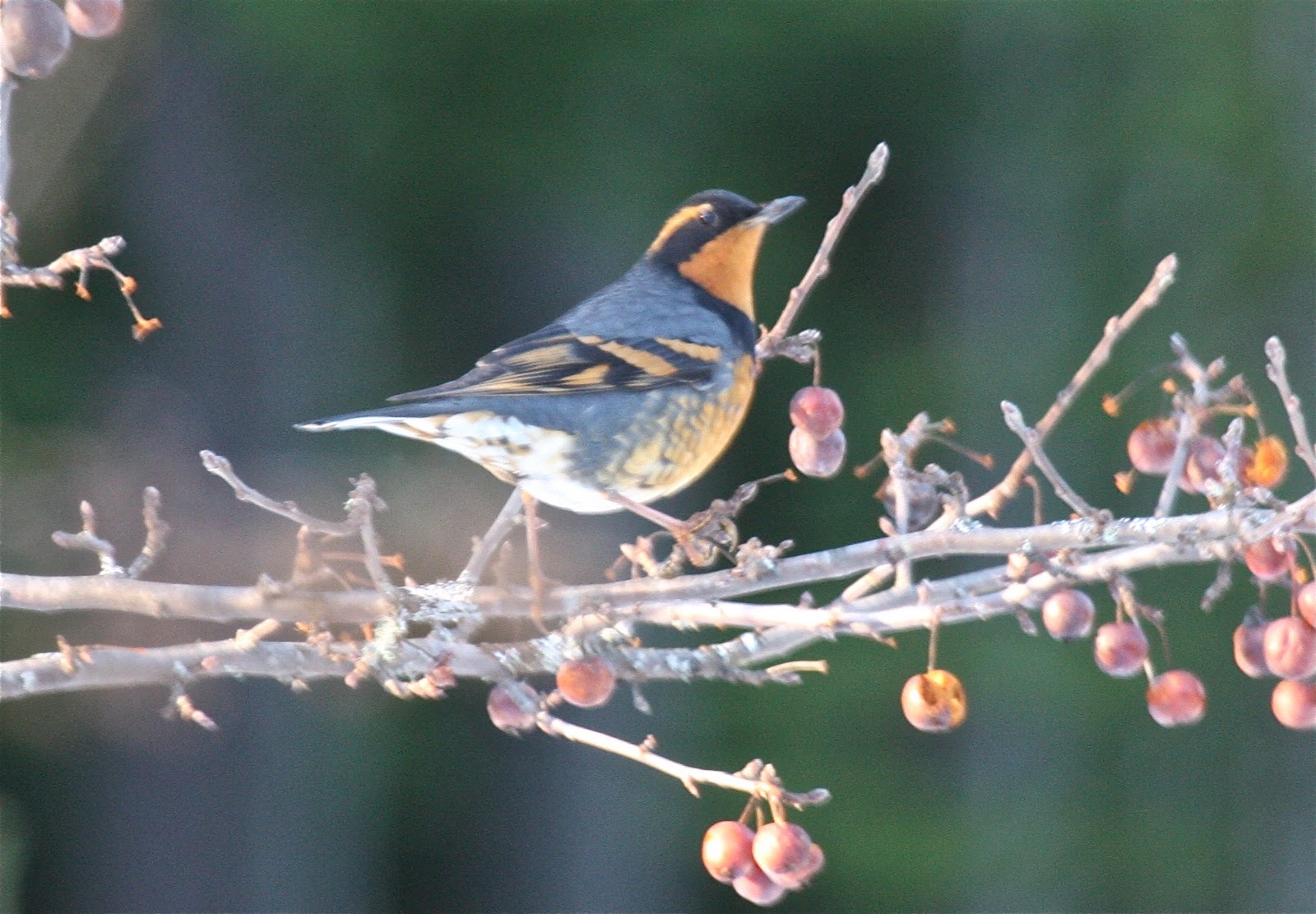
This Varied Thrush had a winter feast on our crabapples.
The wild creatures are a huge part of our quality of life. It's one of the reasons Sue and I support Whidbey Camano Land Trust in their work to preserve farms, forests and other healthy habitat.

I've gradually learned we don’t have to control everything. Better to leave nature alone as much as reasonably possible so it can create something beautiful. If we interfere too much, we’ll just screw it up and make a poorly-functioning, problematic mess.

Sue and I were guests recently at the waterfront home of a gracious couple who live on a high bluff overlooking Puget Sound. They watch boats all day.  They are enjoying their golden years dining on crabs and salmon they catch from their own boat in front of their own home. It’s the Puget Sound dream!

What could be healthier than fresh salmon?  Well, just not too much, too often, because the flesh might be somewhat toxic. The experts say it's probably safe in moderation, but be careful if you're pregnant or nursing. That's the flip side of the Puget Sound dream.

This handsome young coyote had a sweet tooth for Gravensteins.
Our friends' view is breathtaking.  But as is typical of high-bluff properties, they have a long pipe called a tight-line that carries roof runoff including any moss-killing products down the bluff to the beach, where forage fish lay their eggs. Salmon feed voraciously on those forage fish, to the extent that they hatch and survive.

This couple’s pride is their perfect front yard, a fairyland of manicured beds, interconnecting lawns, vegetable plots and winding paths. They've cleared the trees and brush and scraped away centuries of ground cover.

"Bubba," the Great-horned Owl, is our rodent police.
Now to their dismay, their new lawn is sprouting buttercups – even after they applied weed-n-feed. Their vision is to gaze at a deep, lush carpet of green, so they asked us about products to kill the broadleafs.

“It depends on your values and vision,” I blurted, then instantly regretted the edge in my voice. The last thing I wanted to do was attack the wonderland our hosts had worked so hard to create.

What I wanted to explain is that beauty means different things to different people. I’ve come to believe the most beautiful and joyful thing in my world is to live in a place that is healthy for wildlife and humans.  Buttercups aren’t so bad. Weeds grow where we disturb the soil, but not where nature runs the show.

Even this guy makes us smile.
Plants need excessive watering when we introduce the wrong ones. Leave nature alone and it will choose the right, drought-tolerant plants. Grass is a good ground cover for septic drain-fields but not much else when you live in a climate of dry summers and moss-promoting winters.

Of course most people don't have the space to live quite as wild as we do. But even in a built-up neighborhood -- in fact especially there -- why not steer away from chemicals?  Keep some natural ground cover and pursue a different vision. Offer the wildlife a sliver of wild habitat, safe food and clean water.  If we all do that, our earth and marine waters will be healthier.

Blacktail deer bring quiet grace to our forest setting.
To me, a few yellow flowers in a lawn aren’t ugly; they’re beautiful. They make a statement about what's really important versus just cosmetic.

They are a sign the birds can bring their young to eat from that lawn without getting poisoned, and that we aren’t poisoning the ground from which we draw the previously-used water we drink every day of our lives.

Everything is connected. Beauty is more than skin deep -- much, much more.

Thursday, March 31, 2011

Another Home Run for the Land Trust

Whidbey Camano Land Trust has just published its 2010 Annual Report and, once again, it is a beauty. Using a handful of extraordinary images, the report conveys the inspiration we islanders draw from our natural environment. It illustrates why we live here and feel such a strong connection to the land.

 Chestnut-backed Chickadee, by Craig Johnson. Click on images to enlarge.
By any measure 2010's blockbuster achievement was saving one square mile of Whidbey Island from development -- the Trillium Community Forest. That was far from the only work the Land Trust did. The  report tells the Trillium story and also highlights several other land protection successes on Whidbey and Camano islands.

If you did not receive the annual report in the mail, click here to visit the Land Trust's website, where you may download and view a PDF of it.

Hummingbirds in the nest in Freeland, ready to fledge. Craig Johnson photo.
If the name "Land Trust" sounds a bit intimidating, the organization is not. Its members and staff are just everyday people who love our island lifestyle and want to help keep some land in forests, farms and wetlands to sustain wildlife and provide places for the public to find peace and rejuvenation. Anyone may become a member simply by making a contribution. Those who contribute year-after-year soon find themselves part of an extended family with some very lovely people who share their great passion for these beautiful islands.

It's no surprise many Land Trust members are bird-lovers, because birds really bring home the importance of healthy habitat in sustaining diverse, highly specialized creatures. Besides, birds just make us happy. Virtually everything the Land Trust does in protecting forests, agricultural lands, shorelines and wetlands supports wild birds, many of whom travel immense distances every year in their continental or worldwide migrations.

For the second year running, Craig and Joy Johnson of Freeland donated wild bird images that make the report so visually stunning. "I just love birds," Craig says. "If my images can inspire someone to do something good for the birds, then I've been successful."

The annual report's graphic designer, Jen Pennington, chose Craig's image of a juvenile, Chestnut-backed Chickadee for the front cover. As a would-be photographer myself, I marvel at the exquisite detail of every feather in that image. Craig photographed the bird as it was being fed by a parent. "I had no way to conceal myself, so the birds knew I was there," he said. "The parent would call the young bird into the vegetation before feeding and I had only a brief window to snap the photo before the bird went deeper."

The report also prominently features Craig's gorgeous image of two newborn Rufous hummingbirds in their nest near Freeland. Craig found the nest when it contained two eggs. He carefully and respectfully documented the birds' development every day from birth until they fledged and flew away, always maintaining a safe distance so he did not interfere with the mother or juveniles in any way.

Northern Harrier (left). Western Tanager (right), by Craig Johnson.
Craig's phenomenal series of daily photographs of the nesting hummingbirds may be found on his website. After you go to the website, click on the link identified as "Rufous Hummingbird Nesting Show.

Craig and Joy Johnson published a children's book inspired by their experiences in photographing the baby hummingbirds in Freeland. The Amazing Hummingbird Story of Red Rufous is on sale in bookshops, gift shops and wild bird stores all over Whidbey Island, and may also be ordered by mail directly from the Johnsons. Click here for a preview of the book. To order, e-mail Joy Johnson at joyofwriting@whidbey.com.